Version 3.4 · dedicated subscriber layer

AI Data Centers

This is the deep-dive destination for the infrastructure story: where facilities are operating, where construction is underway, what is proposed, and how each project sits in relation to the Ogallala Aquifer, communities, and public groundwater information.

The page is designed to hold the facility graphics already prepared for the Tracker while keeping the public-facing map simple enough to understand at a glance.

Evidence rule: a data center appearing on the map is geographic and development-status context. It is not, by itself, proof that the facility caused a nearby groundwater decline. Facility water claims, permit records, monitoring data, and independent measurements must remain clearly separated.
Living Facility Registry19 mapped locations · 17 loaded power profiles · Last verified · Approved, source-supported changes only
Review facility records

Operational

Facilities that have entered operation, labeled with the best verified date and source available.

Under construction

Projects with active construction evidence. Construction status does not imply that full operations have begun.

Proposed

Announced, planned, or proposed projects that have not yet reached the operational category.

Explore the AI Data Centers on the Aquifer

2050 view · Select a data-center marker to open its corresponding facility profile, current updates, and subscriber discussion.

How large are the power requirements?

All 17 loaded facility profiles appear below. Every reported figure is converted to megawatts. “Small facilities visible” uses a logarithmic width so tens of megawatts can be seen beside gigawatt projects; “actual scale” restores direct proportional size.

Documented or announced facility loadPower-supply or campus envelope—not verified loadUnverified profile claimDemand not publicly disclosed
Facility profile1 MW100 MW17,000 MWReported figure

How to read this: megawatts measure instantaneous power, not annual energy. A renewable-energy contract or proposed onsite power plant is not automatically the facility’s electrical demand. Those supporting-supply figures are hatched and labeled separately. “Not disclosed” is unknown—not zero. Project Matador’s 17,000-MW campus vision, for example, is distinct from its currently reported 222-MW TensorWave lease.

Key supporting records: Fermi America · Laramie County · Vantage · PowerHouse · Aligned Caprock comparison. Each facility profile below retains its complete source trail.

Facility profile library

Seventeen of the approved 19 facility graphics are now loaded. Select a facility tab to open its complete profile image, recent-news area, and subscriber discussion space. The interactive map provides exact geographic context.
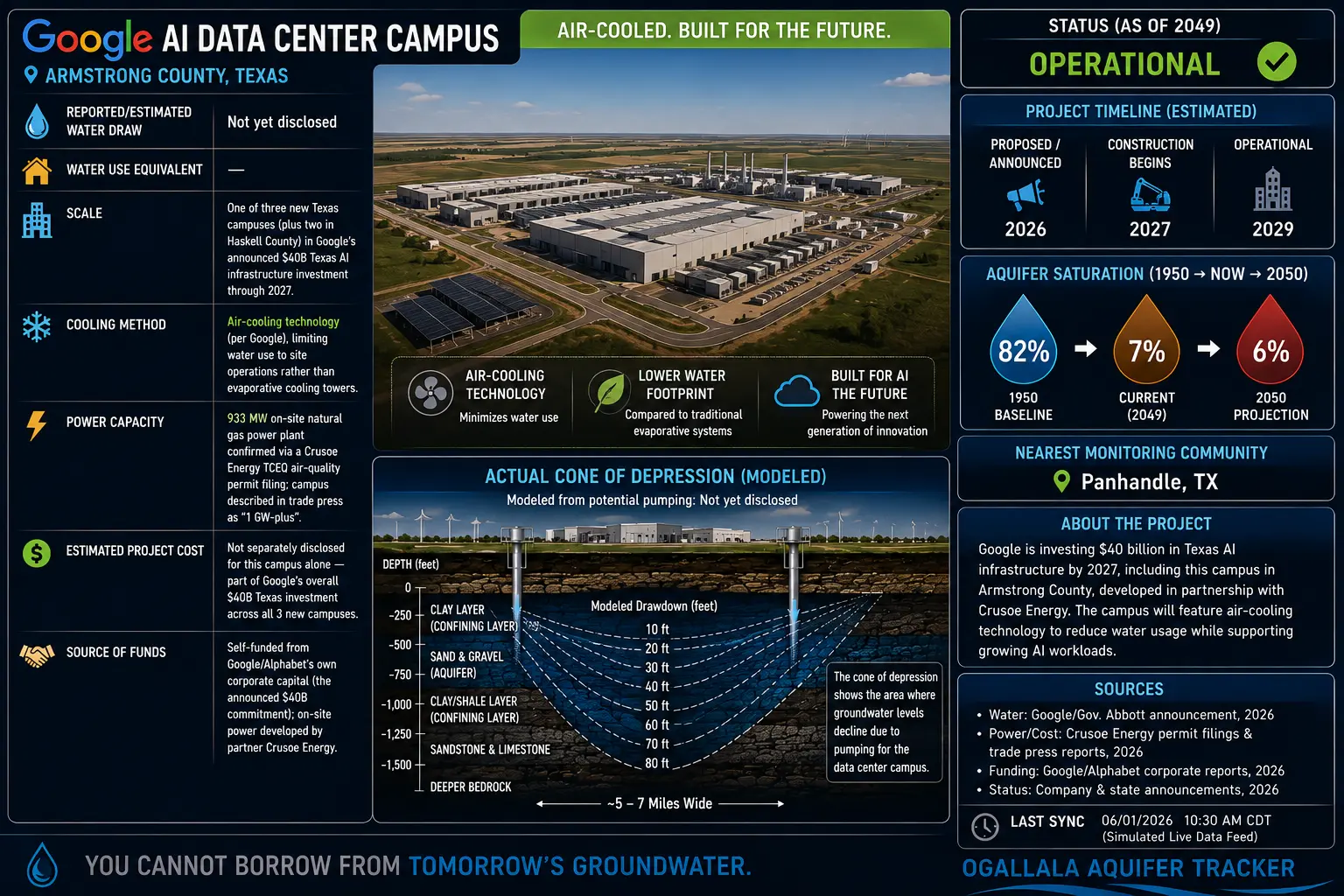
Google AI Data Center Campus — Armstrong County, Texas

Google AI Data Center Campus facility profile for Armstrong County, Texas

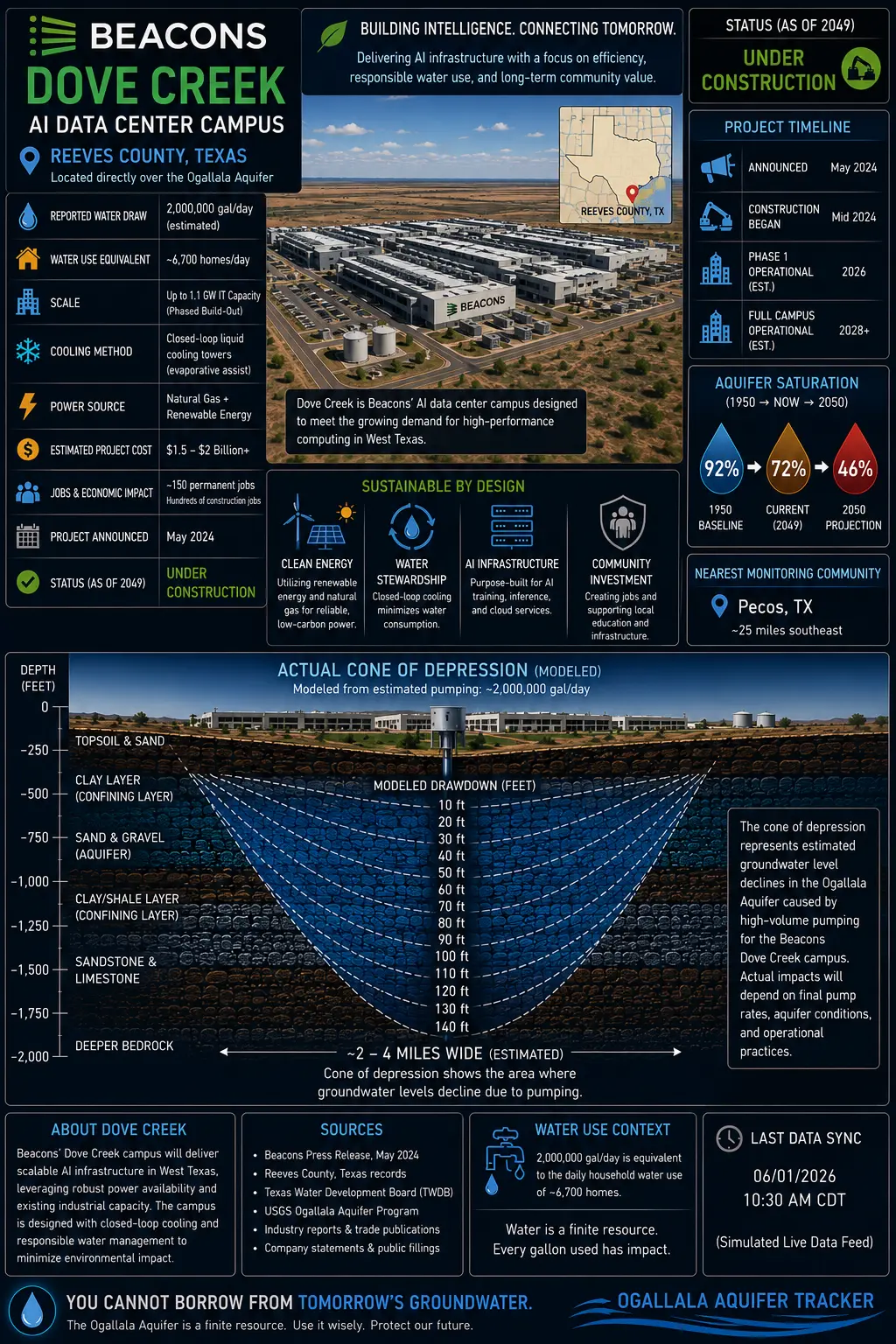
Beacons Dove Creek — Texas

Beacons Dove Creek AI Data Center Campus facility profile for Reeves County, Texas

Recent Facility News

Current records and reporting identified for Beacon’s Dove Creek proposal.

Location verification: the supplied graphic says Reeves County, but the sources below place Beacon’s Dove Creek Technology Campus in Tom Green County near San Angelo. The original image is preserved while this conflict is reviewed.
Subscriber discussion preview

Discuss this facility

Members will be able to share sourced local observations and discuss water, energy, permits, and community impacts.
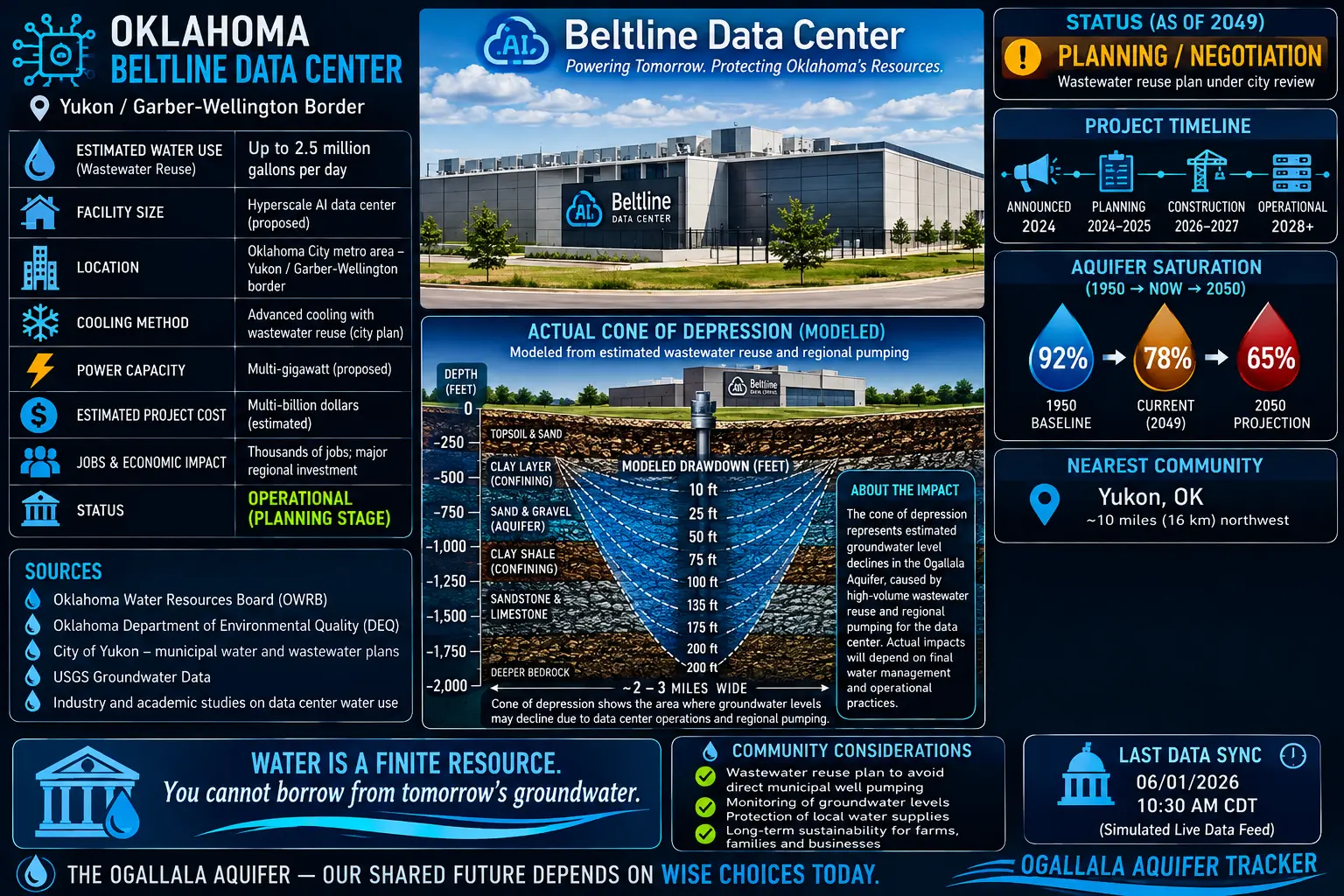
Oklahoma Beltline Data Center — Oklahoma City–Yukon Border

Oklahoma Beltline Data Center facility profile near Yukon, Oklahoma

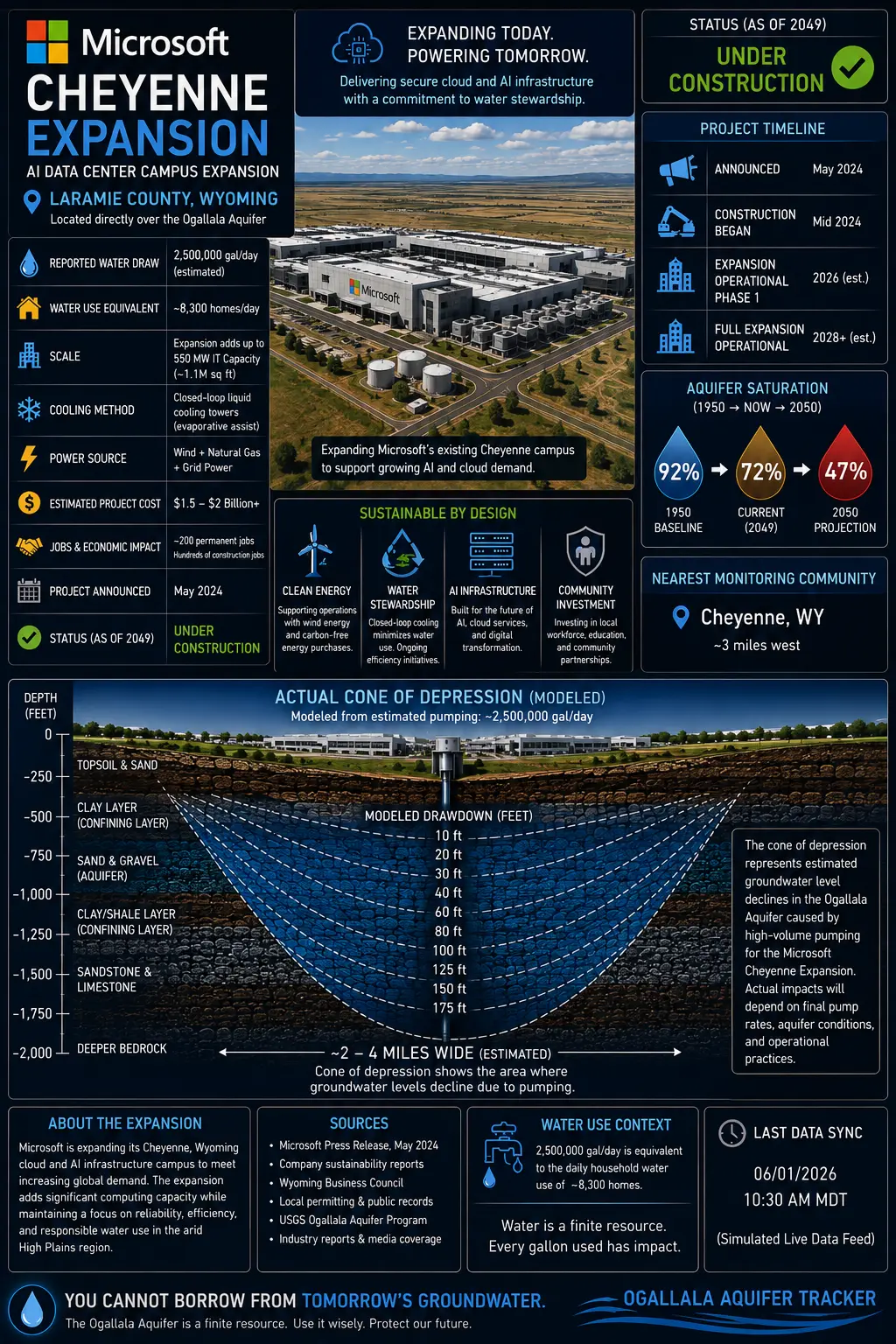
Microsoft Cheyenne Data Center Expansion — Laramie County, Wyoming

Microsoft Cheyenne AI Data Center Campus Expansion facility profile in Laramie County, Wyoming

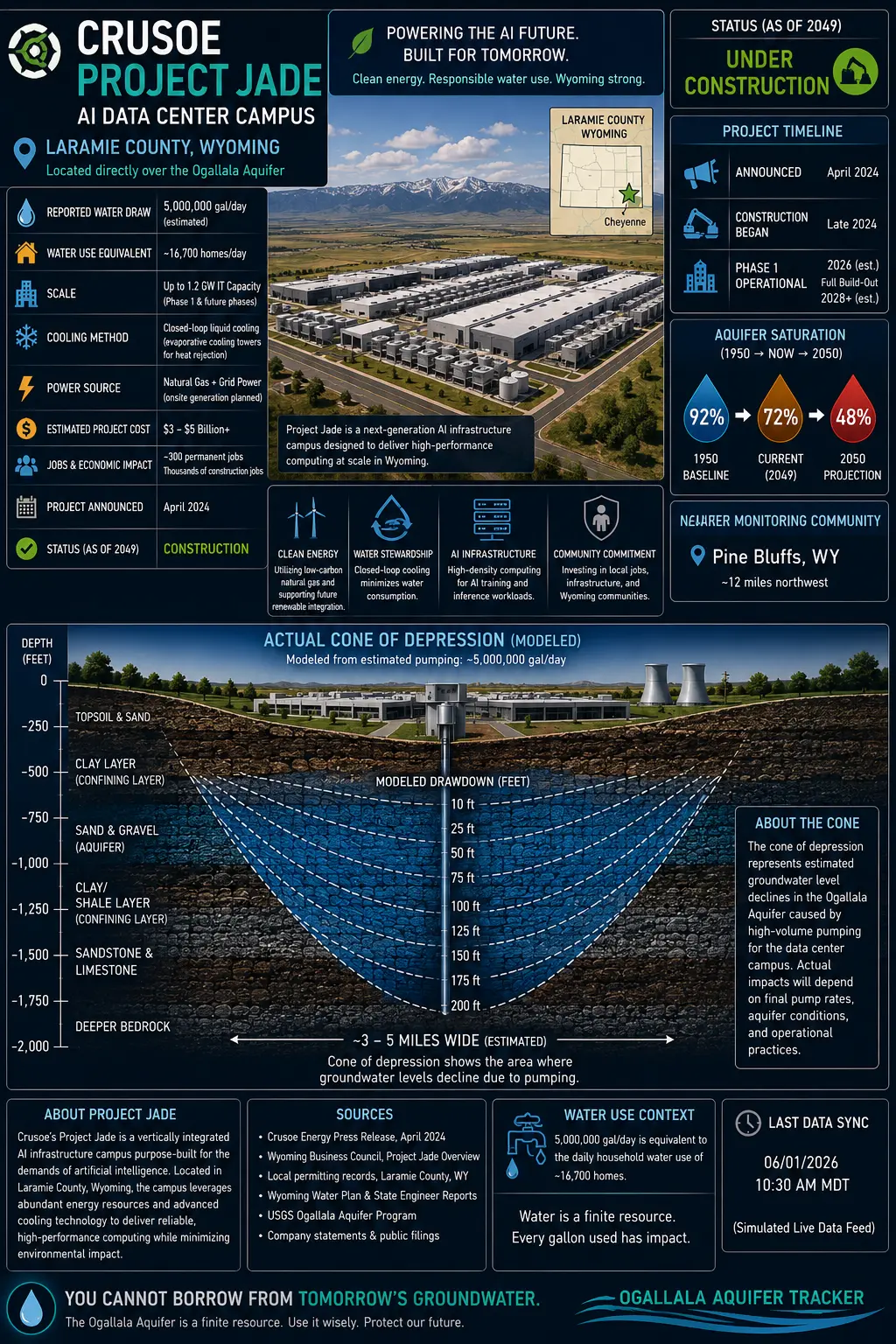
Crusoe Project Jade — Laramie County, Wyoming

Crusoe Project Jade AI Data Center Campus facility profile in Laramie County, Wyoming

Recent Facility News & Public Records

Current county records and reporting tracking the major ownership and development change affecting the supplied Project Jade profile.

Current status update: the supplied image preserves the original Crusoe Project Jade proposal. Laramie County reported in July 2026 that Crusoe withdrew and that the revised application is now Project Tembo, involving Google operating as Jupiter Star Holdings, LLC.
Subscriber discussion preview

Discuss this facility

Members will be able to share sourced local observations and discuss water, energy, permits, ownership changes, and community impacts.
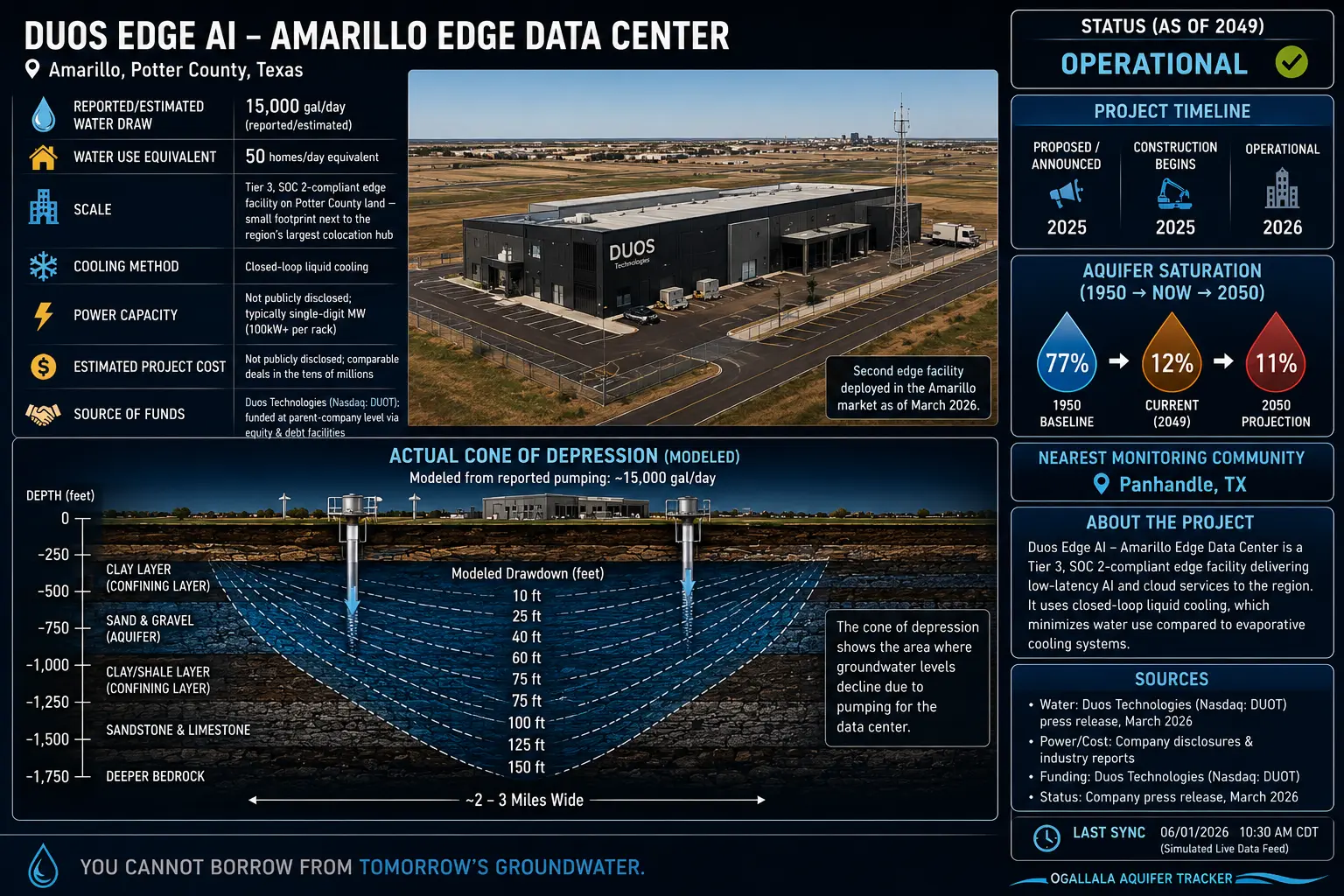
Duos Edge AI — Amarillo Edge Data Center, Potter County, Texas

Duos Edge AI Amarillo Edge Data Center facility profile in Potter County, Texas

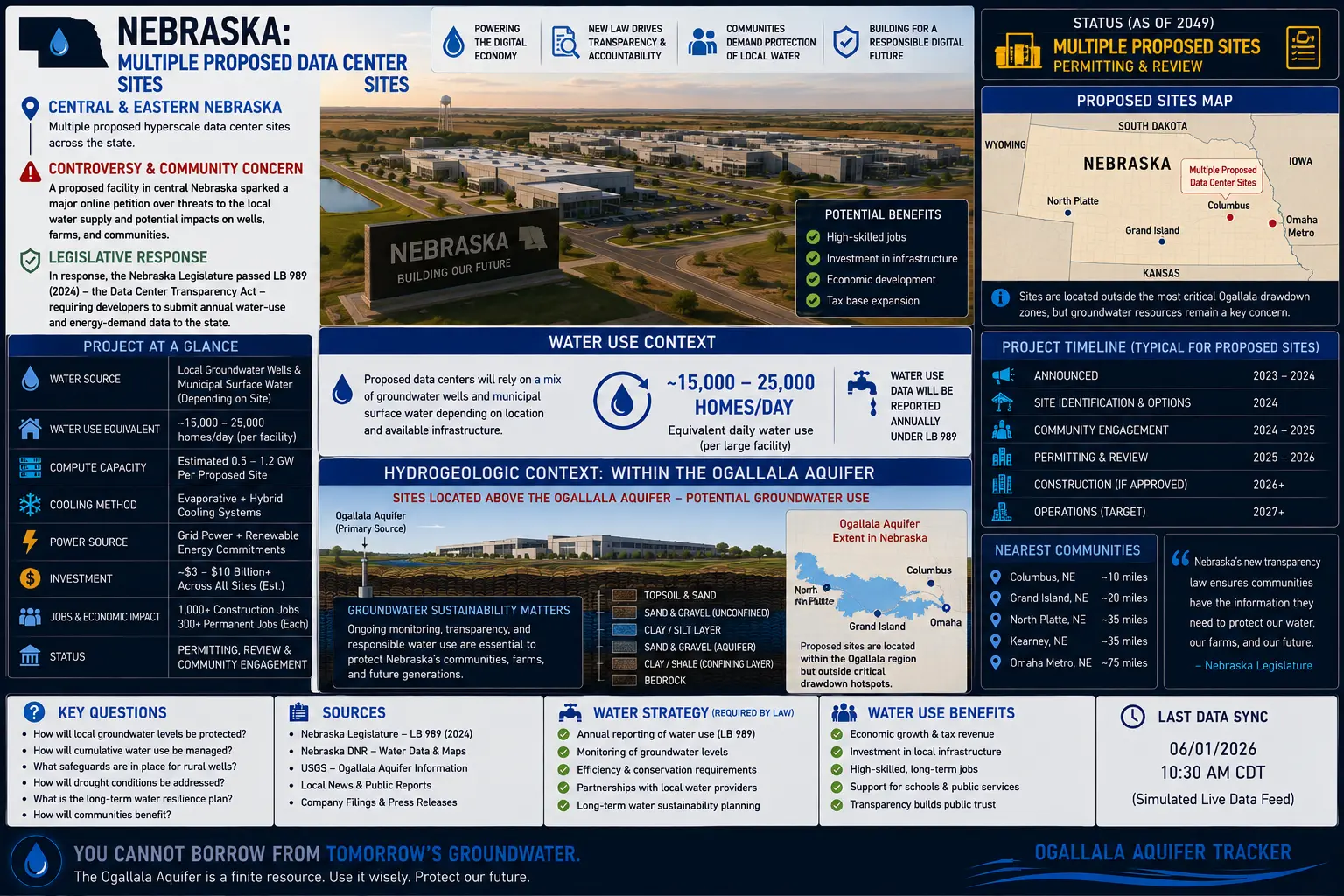
Nebraska — Multiple Proposed Data Center Sites

Nebraska multiple proposed data center sites facility profile

Recent News, Law & Public Records

Statewide reporting, Nebraska law, executive action, and community-level coverage relevant to proposed data-center development.

Legislative record update: the supplied graphic cites “LB 989 (2024)” as Nebraska’s Data Center Transparency Act. Official legislative records do not support that citation. Current reporting requirements are contained in Nebraska law at §70-1506 following 2026 legislation, including provisions developed through LB 1111 and enacted through LB 1010.
Subscriber discussion preview

Discuss Nebraska’s proposed sites

Members will be able to share sourced local observations and discuss water, power, zoning, legislation, public benefits, and community impacts.
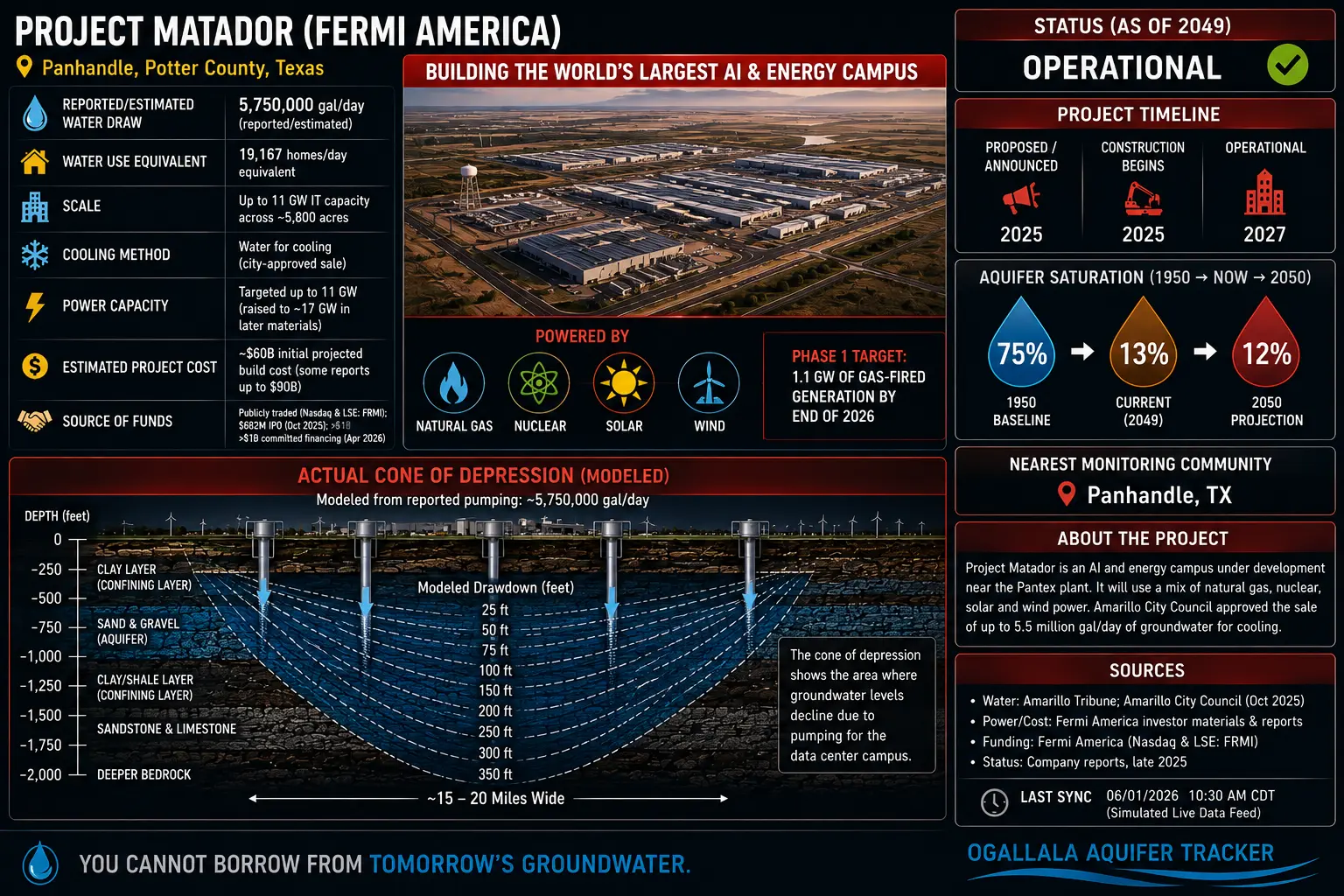
Project Matador — Fermi America, Texas Panhandle

Fermi America Project Matador AI and energy campus facility profile in the Texas Panhandle

Recent Facility News & Public Records

Current city records, company milestones, local reporting, and independent coverage tied to Project Matador.

Current-record note: the preserved artwork reports a 5.75-million-gallon daily estimate and describes the site as Potter County. The City of Amarillo’s published agreement concerns up to 2.5 million gallons per day, while recent project reporting places the main campus in Carson County. The interactive map and linked records provide the current geographic and water-supply context.
Subscriber discussion preview

Discuss Project Matador

Members will be able to share sourced local observations and discuss water, power generation, permits, financing, public benefits, and community impacts.
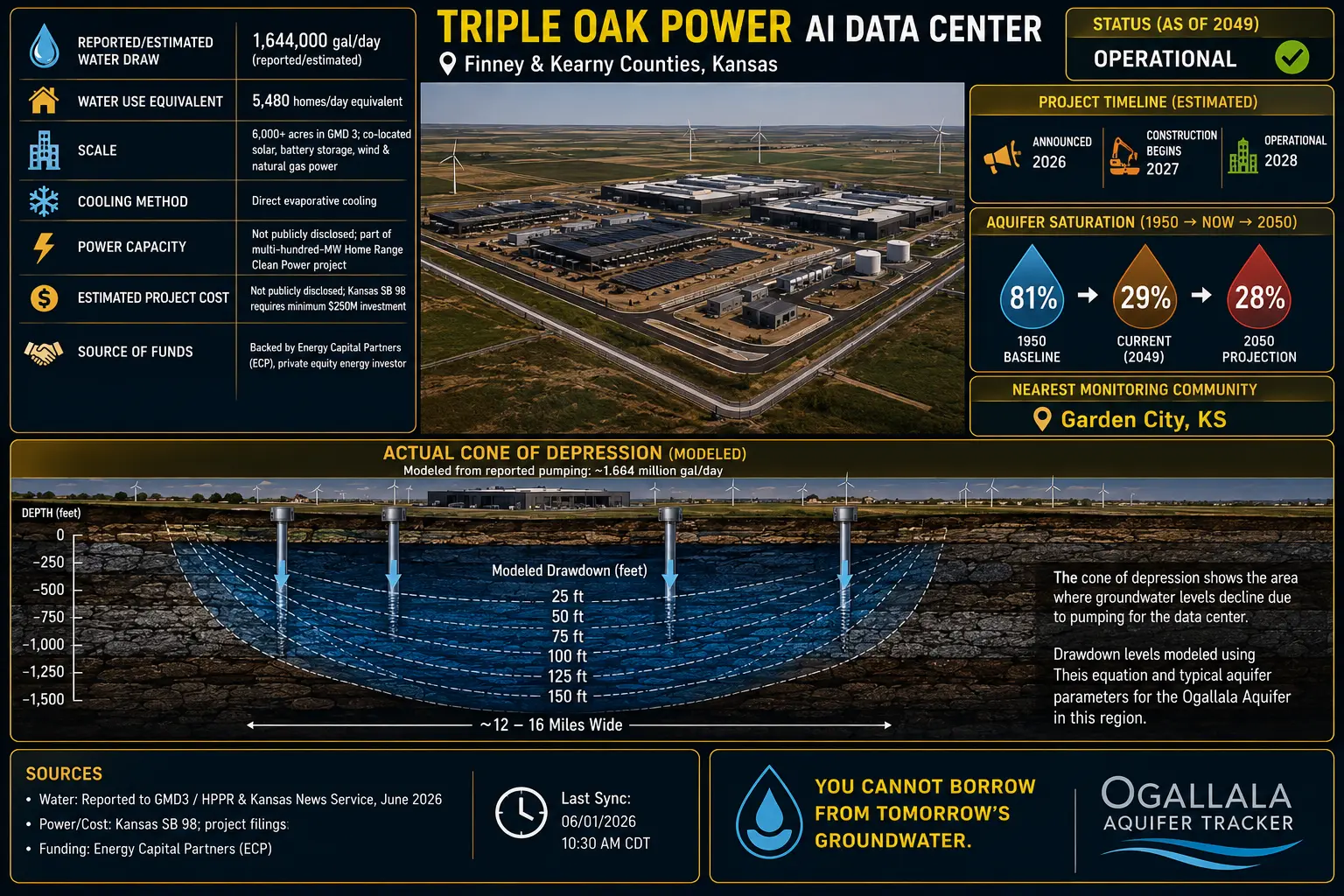
Triple Oak Power — Home Range Clean Power, Kansas

Triple Oak Power AI data center profile for Finney and Kearny Counties, Kansas

Recent Facility News & Public Records

Current local reporting, county action, company information, and Kansas law tied to the Home Range proposal.

Current-status note: the supplied artwork presents a future data-center buildout. Triple Oak’s official Home Range site currently describes the energy project as proposed and says it is discussing the area with a large energy customer considering a future data center; the power is not yet contracted and no data-center tenant is identified. Local reporting says Triple Oak estimated 600 million gallons per year—about 1.64 million gallons per day—if the data center proceeds.
Subscriber discussion preview

Discuss Triple Oak Home Range

Members will be able to share sourced local observations and discuss water rights, irrigation conversion, power generation, permitting, public benefits, and community impacts.
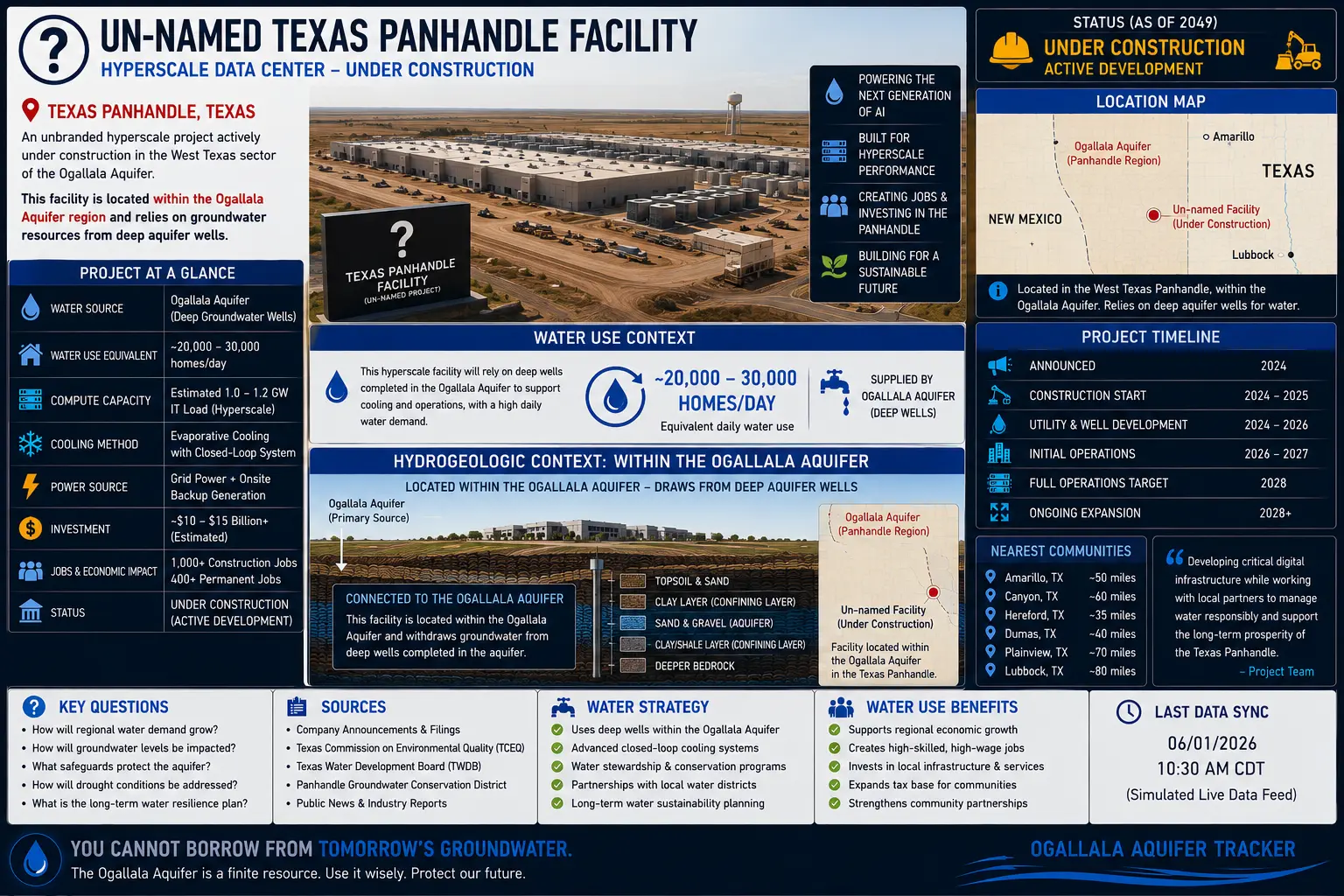
Unnamed Texas Panhandle Hyperscale Facility

Unnamed Texas Panhandle hyperscale data center facility profile

Recent Facility News & Public Records

Current regional records used to test the identity and claims in this unnamed-facility profile.

Identity and evidence note: no public record reviewed identifies a Texas Panhandle project matching all of the supplied artwork’s claims—1.0–1.2 gigawatts, $10–15 billion, evaporative cooling, deep aquifer wells, and an unnamed active developer. The closest clearly verified regional construction project is Aligned Data Centers’ Project Caprock near Abernathy, but its published record differs: 540 megawatts, 313 acres, approximately $5 billion, and a closed-loop system with air-cooled heat rejection. The image is preserved as submitted and is not being relabeled as Caprock without stronger evidence.
Subscriber discussion preview

Discuss the unnamed Texas Panhandle profile

Members will be able to submit sourced identity leads and discuss location, ownership, construction status, cooling design, water permits, energy supply, and community impacts.
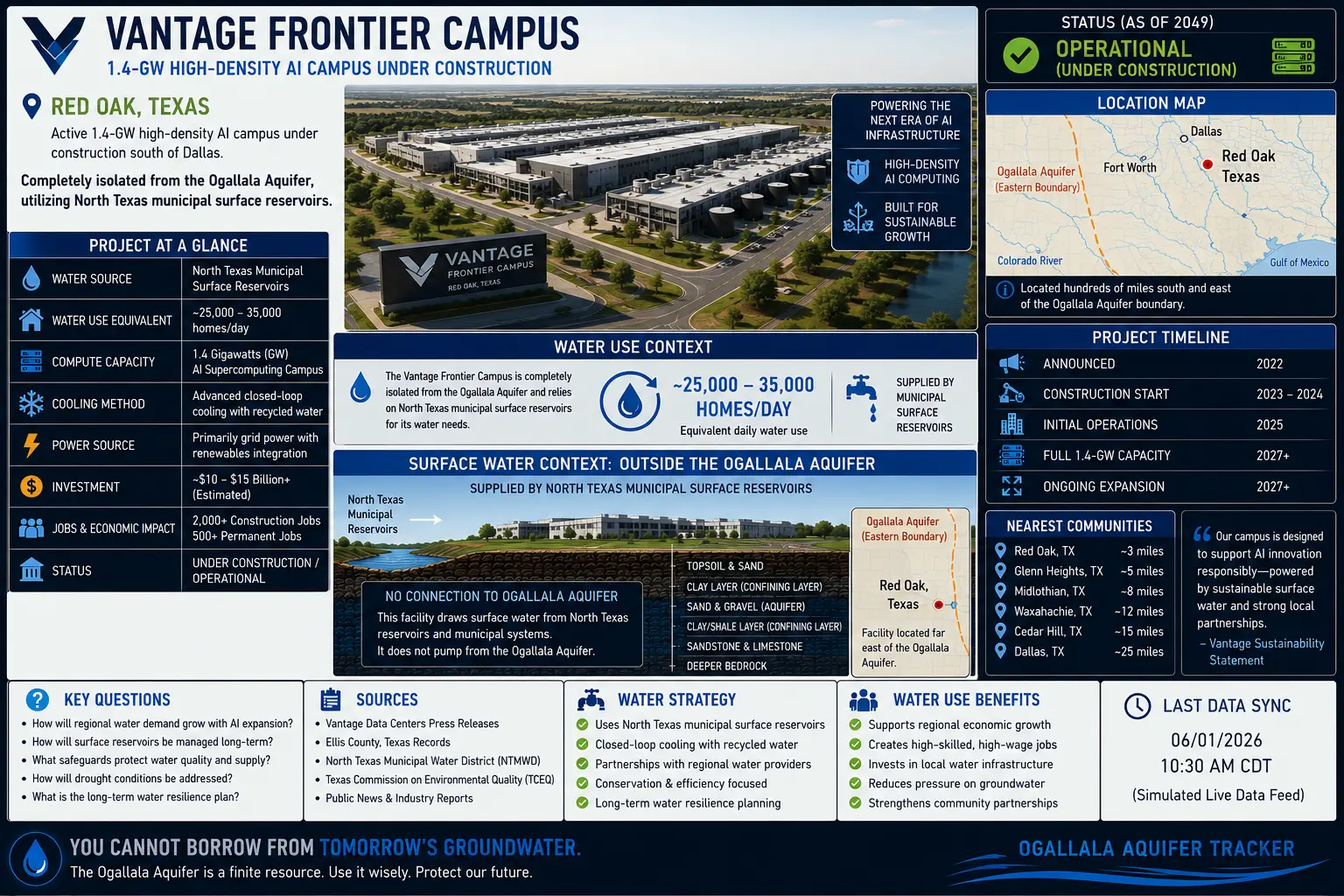
Vantage Frontier Campus — Shackelford County, Texas

Vantage Frontier 1.4-gigawatt AI data center campus profile

Recent Facility News & Public Records

Current company information, county context, local reporting, and independent coverage tied to Vantage’s Frontier campus.

Location and project-record correction: the supplied artwork identifies Red Oak, Texas. Vantage’s official Frontier records place the 1.4-gigawatt campus in Shackelford County near Abilene, on approximately 1,200 acres. Vantage reports an investment exceeding $25 billion—not $10–15 billion—and a closed-loop chilled-water design with near-zero operational water utilization. Red Oak contains other data-center projects, but it is not the documented location of Vantage Frontier.
Subscriber discussion preview

Discuss Vantage Frontier

Members will be able to share sourced local observations and discuss cooling performance, power supply, construction, incentives, employment, water verification, and community impacts.
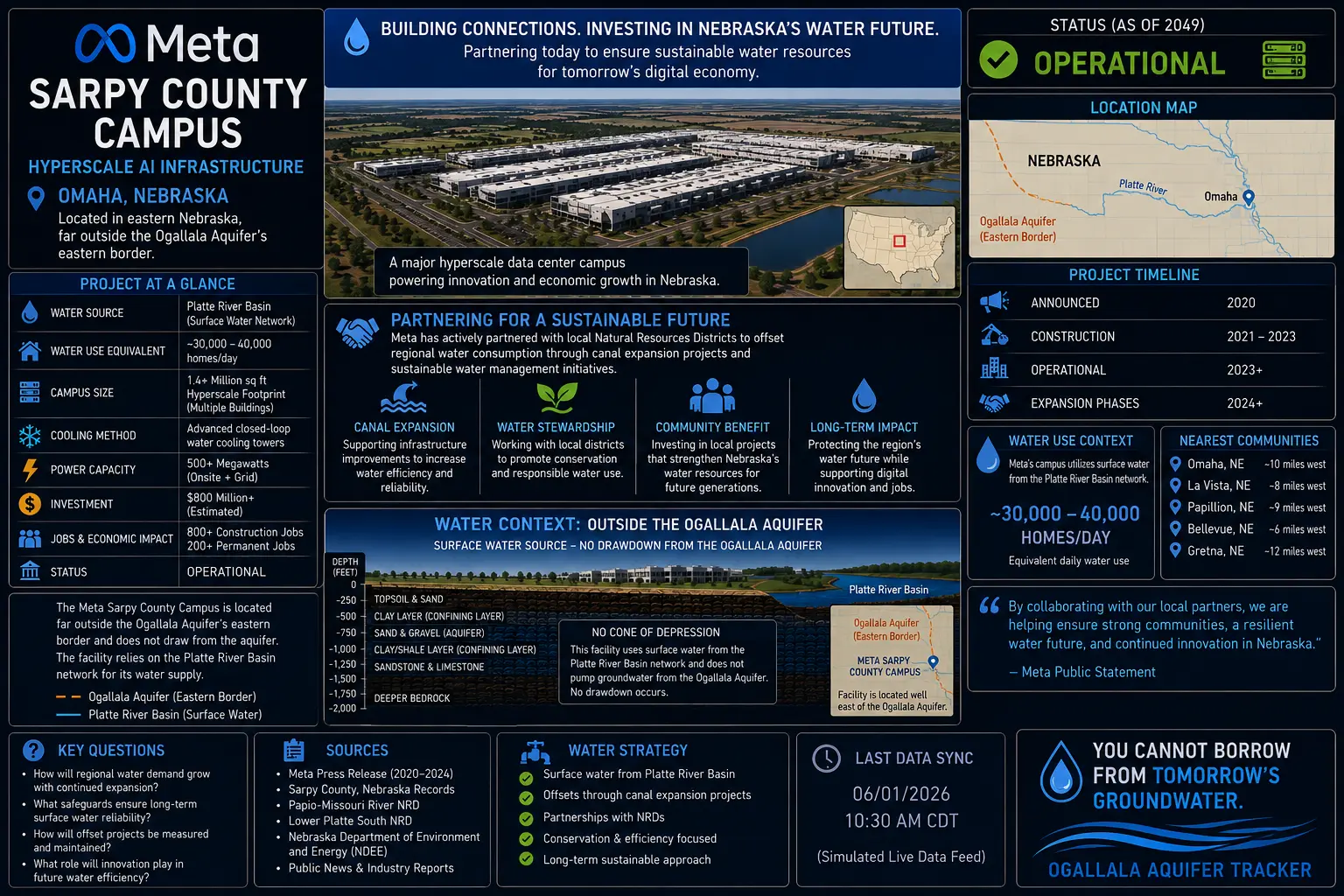
Meta Sarpy County Data Center — Nebraska

Meta Sarpy County data center campus profile in Nebraska

Recent Facility News & Public Records

Current company information, Nebraska reporting, state water context, and local community records tied to Meta’s Sarpy campus.

Facility-record correction: the supplied artwork labels the campus “Omaha,” gives a 1.4-million-square-foot footprint, equates water demand to 30,000–40,000 homes per day, and describes closed-loop cooling towers. Current records place the campus near Papillion and Springfield, describe roughly 4 million square feet, and report annual withdrawals of 26.7–37.5 million gallons from 2020–2024—about 73,000–103,000 gallons per day. Current reporting describes a combination of evaporative and closed-loop cooling. The campus is east of the Ogallala Aquifer, but its actual local supply and watershed impacts remain appropriate subjects for verification.
Subscriber discussion preview

Discuss Meta Sarpy County

Members will be able to share sourced local observations and discuss municipal supply, cooling systems, water reporting, expansion, power demand, incentives, grants, and community impacts.
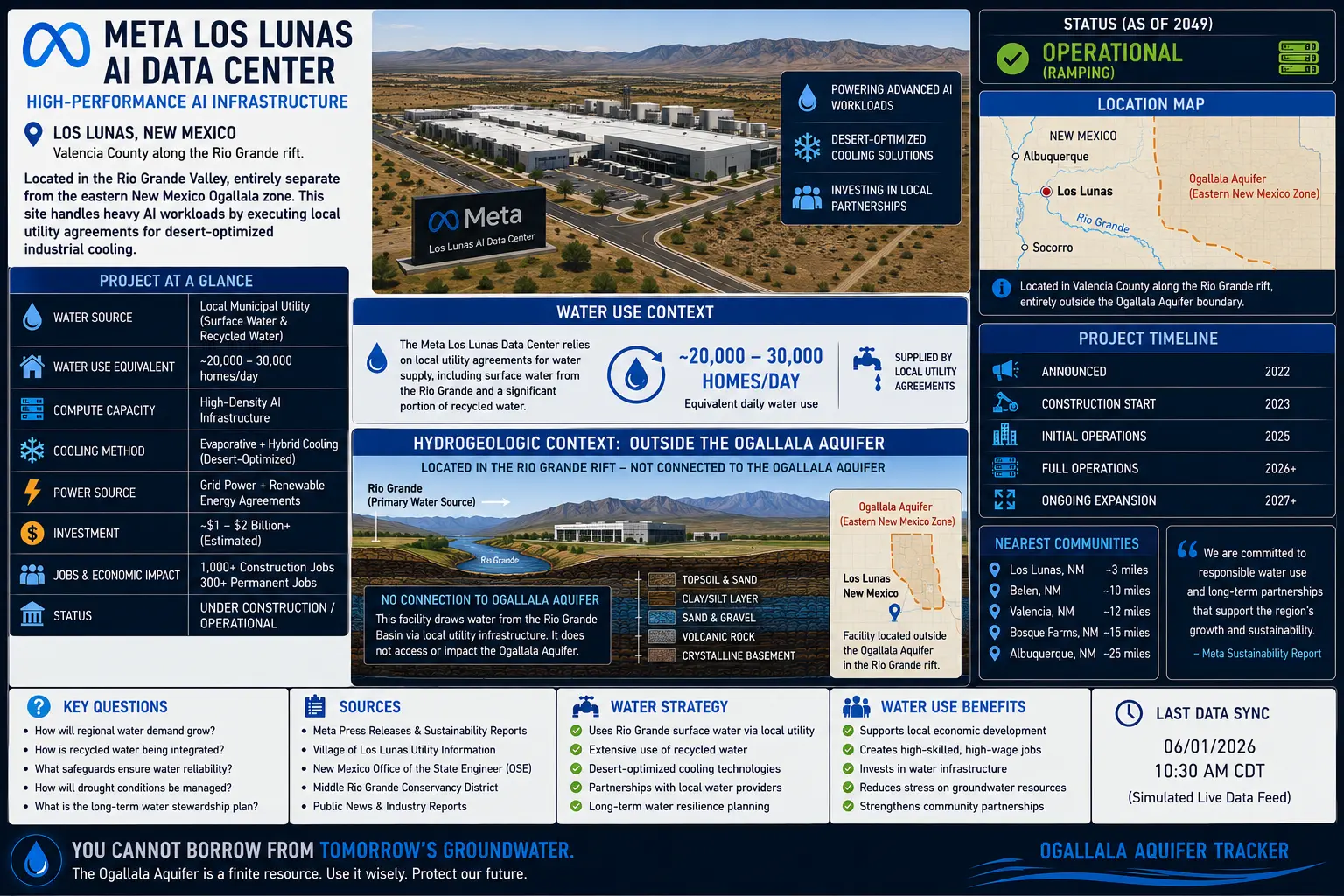
Meta Los Lunas Data Center — New Mexico

Meta Los Lunas data center campus profile in Valencia County, New Mexico

Recent Facility News & Public Records

Current company information, Los Lunas government action, independent expansion reporting, and New Mexico water context tied to Meta’s campus.

Facility-record correction: the supplied artwork says the campus was announced in 2022, began construction in 2023, and represents a $1–2 billion investment. Meta’s current record says it broke ground in 2016, has invested more than $2.5 billion, and supports more than 400 operational jobs. A further two-building, approximately $800 million expansion was approved in late 2024 and reported in January 2025. The image’s 20,000–30,000-homes-per-day water equivalency and specific Rio Grande/recycled-water supply description are not supported by the official sources reviewed; Meta’s fact sheet describes water-efficient cooling and repeated reuse before wastewater discharge but does not publish that daily demand figure.
Subscriber discussion preview

Discuss Meta Los Lunas

Members will be able to share sourced local observations and discuss municipal supply, water rights, cooling systems, expansion, industrial-revenue bonds, power demand, employment, grants, and community impacts.
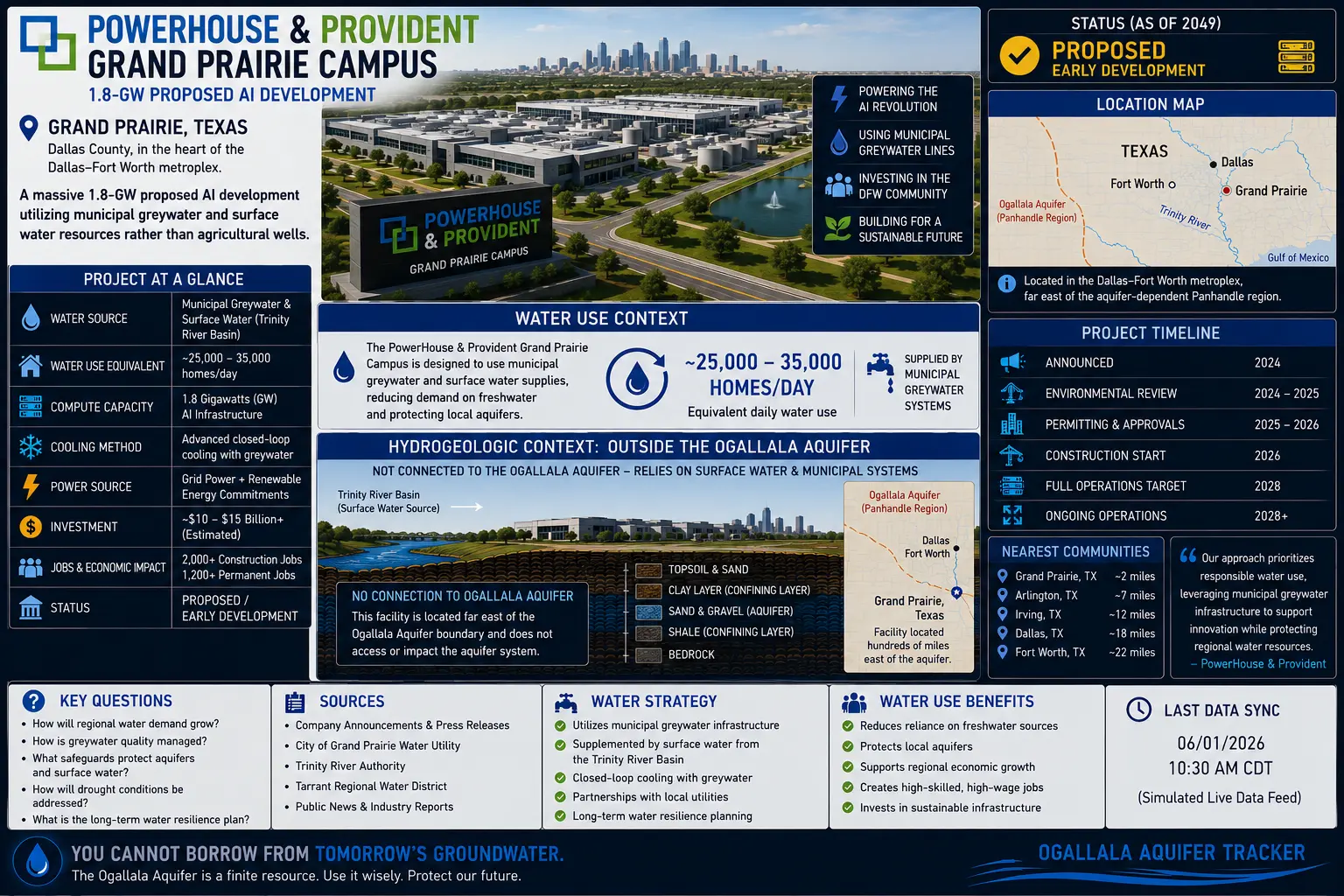
PowerHouse & Provident Grand Prairie Campus — Texas

PowerHouse and Provident Grand Prairie data center campus profile in northern Ellis County, Texas

Recent Facility News & Public Records

Current developer information, independent reporting, project records, and Texas regulatory context tied to the Grand Prairie campus.

Location, schedule, and water-evidence correction: the supplied artwork places the campus in Dallas County and describes a 2024 announcement, 2026 construction start, $10–15 billion investment, municipal greywater cooling, and water use equal to 25,000–35,000 homes per day. Current developer records place it just outside Grand Prairie in northern Ellis County, say the venture was announced in 2025, and describe a permitted project still in design and engineering. The current AREP property page lists roughly 810 acres, 29 buildings, two phases, and first energization in Q4 2026. The reviewed public sources do not substantiate the artwork’s investment, cooling-water source, or household-equivalency figures, so those remain unverified.
Current · American Real Estate Partners · Official property recordDeveloper updates Grand Prairie’s footprint and delivery scheduleThe current page describes an approximately 810-acre, 8.5-million-square-foot campus with 29 buildings in two phases, approvals and permits secured, design and engineering underway, and first energization targeted for Q4 2026. February 25, 2025 · PowerHouse Data Centers · Company announcementPowerHouse and Provident announce the 1.8-gigawatt Grand Prairie ventureThe original announcement placed the 768-acre site in northern Ellis County, documented ERCOT approval for an initial 500-megawatt tranche, and said design and engineering were underway. February 26, 2025 · Data Center Dynamics · Independent reportingIndependent coverage confirms the developers, county, scale, and phased planReports the 1.8-gigawatt switchyard, first 500-megawatt ERCOT approval, northern Ellis County location, and the original 24-building, three-phase development plan. February 17, 2026 · City of Grand Prairie · Local-government recordCity Council agenda provides the current public-hearing and data-center zoning contextThe official meeting record includes data-center land-use items and directs residents to the city’s agenda packets and public-comment process for zoning decisions. August 4, 2026 · Reuters · State regulatory reportingTexas pauses new grid approvals while auditing data-center demandThe statewide review requires closer disclosure of power, water, ownership, incentives, and local-impact mitigation; its application to already-approved Grand Prairie phases should be verified through ERCOT and developer updates.
Subscriber discussion preview

Discuss PowerHouse Grand Prairie

Members will be able to share sourced local observations and discuss zoning, permits, ERCOT approvals, water and cooling disclosures, construction status, incentives, employment, and community impacts.
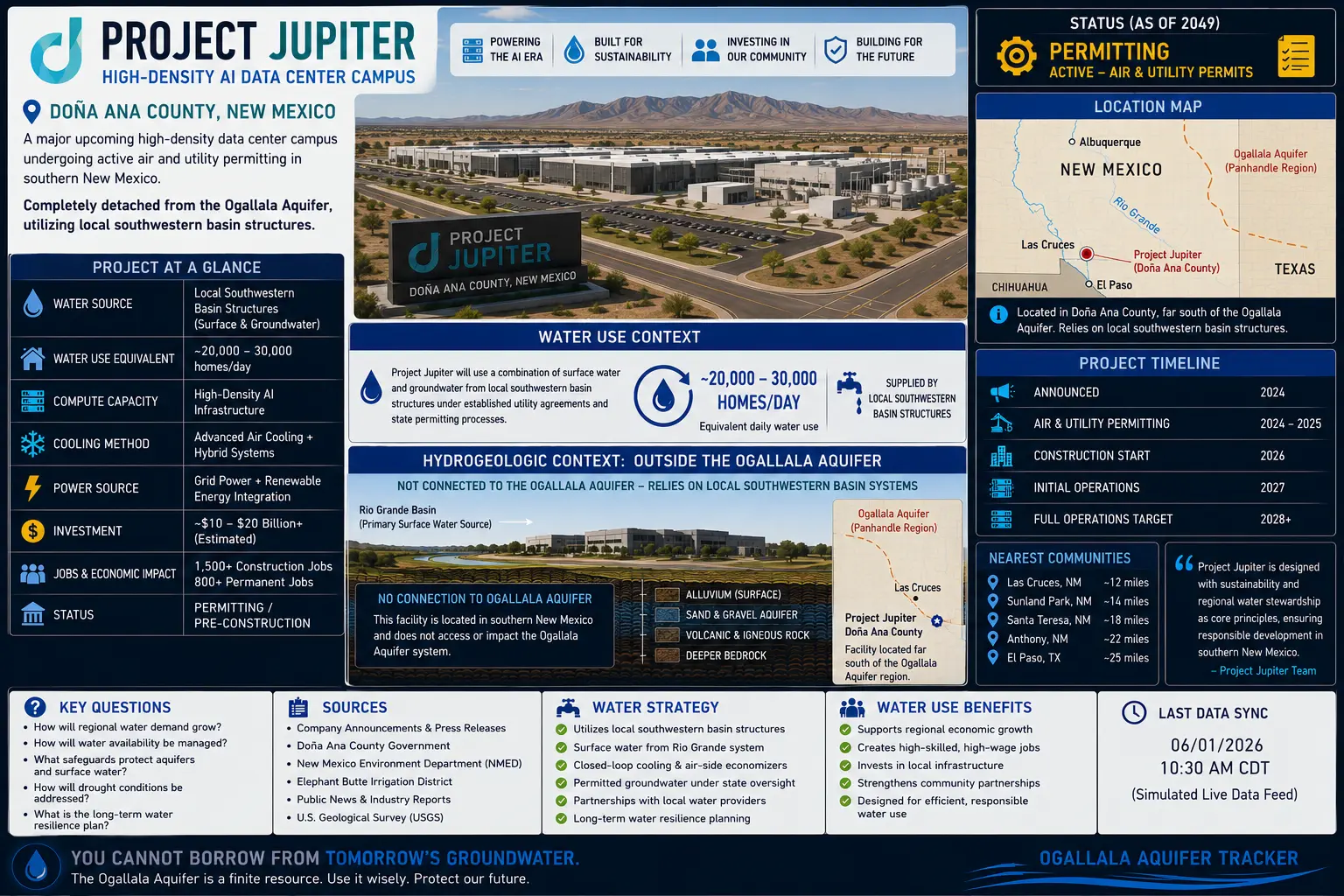
Project Jupiter — Doña Ana County, New Mexico

Project Jupiter AI data center campus profile in Doña Ana County, New Mexico

Recent Facility News & Public Records

Current county commitments, state permitting, construction reporting, financing, and community scrutiny tied to Project Jupiter.

Status, scale, and water correction: the supplied artwork describes a 2024 announcement, pre-construction permitting, a $10–20 billion investment, 1,500 construction jobs, and water use equal to 20,000–30,000 homes per day. Current records identify BorderPlex Digital Assets and STACK Infrastructure as developers, Oracle as the principal technology participant, and show active construction with hundreds of workers onsite. Doña Ana County states that full-build potable use will average 20,000 gallons per day and peak at 60,000 gallons per day through a closed-loop system—dramatically below the artwork’s household equivalency. The county approved up to $165 billion in industrial revenue bonds; that is financing authority, not a verified construction-cost figure. The project’s proposed power system and related air permit remain active, disputed, and subject to state proceedings.
Current · Doña Ana County · Official commitments recordCounty publishes Project Jupiter’s water, employment, and infrastructure commitmentsThe county says potable water will come from CRRUA/Doña Ana County, closed-loop cooling will average 20,000 gallons per day with a 60,000-gallon peak cap, and the companies committed $50 million for water-system improvements. Current · Project Jupiter · Developer informationProject site reports construction activity, jobs, taxes, and revised energy claimsThe developers report more than 700 New Mexico residents working onsite, a projected 7,000 construction jobs, 1,500 ongoing supported jobs, and a revised independent power plan. Current · New Mexico Environment Department · State permitting recordNMED provides the official path for air-permit notices, hearings, and appealsThe state’s public-notice and docket system is the controlling source for Project Jupiter’s proposed power facility, public comments, hearing documents, and subsequent permit decisions. July 7, 2026 · Source New Mexico · Statehouse reportingNMED schedules a public hearing on Project Jupiter’s air-quality permitReports the state proceeding over the project’s proposed onsite power system and summarizes concerns raised by residents and environmental organizations. November 7, 2025 · Reuters · Financial reportingBanks arrange an $18 billion loan for the Oracle-linked New Mexico campusReports project financing tied to the Stargate initiative and identifies Oracle as the expected major tenant, while distinguishing the loan from the county’s much larger bond authorization. July 2, 2026 · KSFR / Source New Mexico · Public-media reportingResidents dispute letters submitted in support of the project’s permitReports allegations that residents’ names appeared on support letters without permission, adding transparency and ethics questions to the ongoing air-permit debate.
Subscriber discussion preview

Discuss Project Jupiter

Members will be able to share sourced local observations and discuss water commitments, CRRUA infrastructure, air permits, onsite power, industrial-revenue bonds, construction, jobs, public participation, and community impacts.
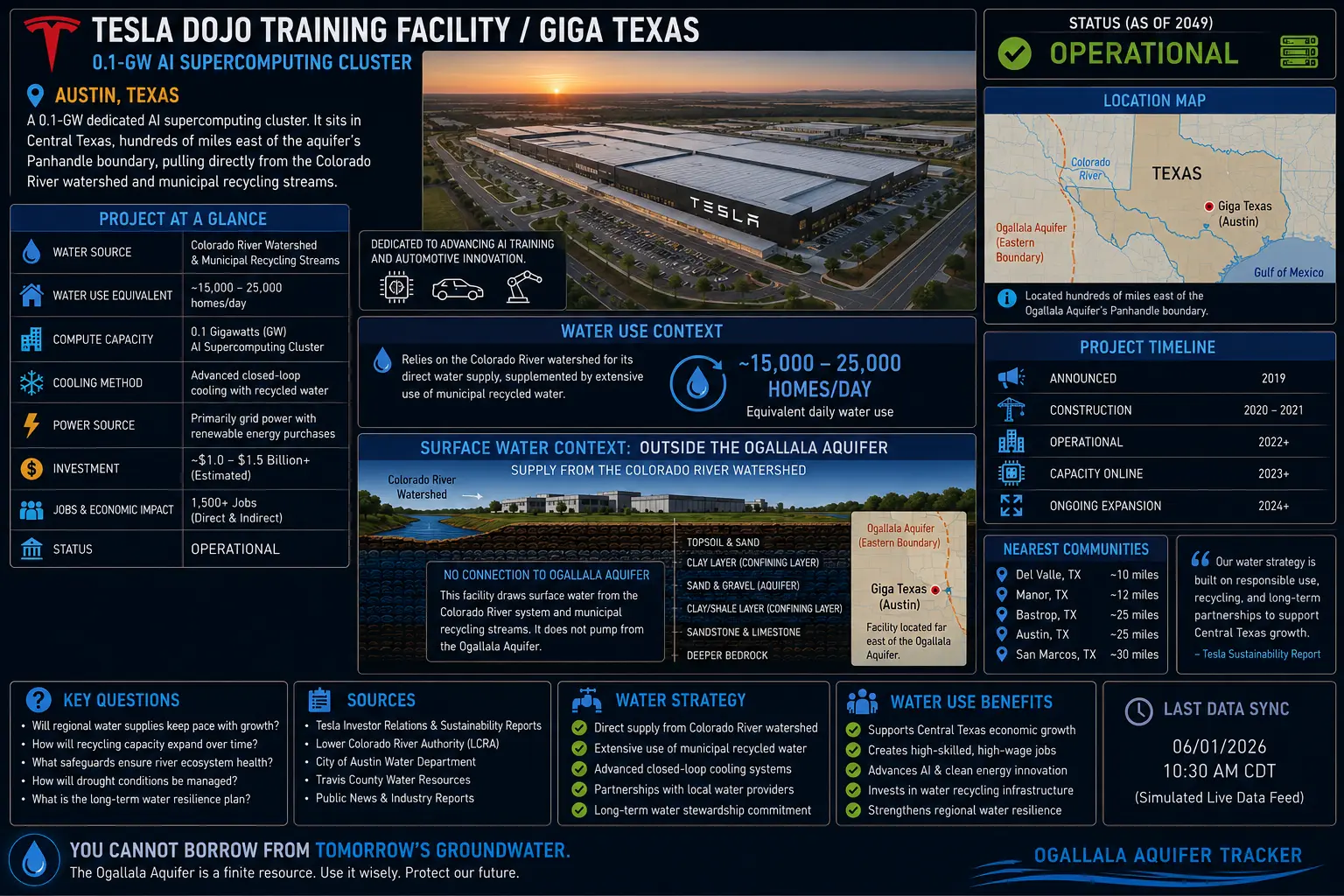
Tesla Cortex AI Training Cluster / Giga Texas — Austin

Tesla AI training cluster and Giga Texas facility profile in Austin, Texas

Recent Facility News & Public Records

Current Tesla information, Austin water reporting, city planning records, and independent coverage of Tesla’s changing AI-compute strategy.

Name, scale, and water-attribution correction: the supplied artwork calls the Austin installation a 0.1-gigawatt “Dojo” facility and assigns it water use equal to 15,000–25,000 homes per day. Tesla named the Giga Texas training cluster Cortex in 2024 and described an initial 130-megawatt power-and-cooling requirement with possible expansion beyond 500 megawatts. Tesla disbanded the separate Dojo team in August 2025 and redirected staff and chip strategy, although later statements discussed a possible Dojo 3 revival. Austin Water data reported in 2026 show the entire Giga Texas industrial complex—not Cortex alone—used 556 million gallons of treated water in 2025, about 1.52 million gallons per day. No reviewed public record supports assigning the artwork’s household-equivalency figure, cooling method, $1–1.5 billion cost, or 1,500 jobs specifically to the AI cluster.
Current · Tesla · Official facility pageTesla identifies Giga Texas as its headquarters and manufacturing hubThe company documents a 2,500-acre site with more than 10 million square feet of factory floor, while not publishing facility-specific Cortex water, cost, or employment figures. August 8, 2025 · Reuters · Independent reportingTesla disbands the Dojo team and redirects its AI-chip strategyReports the departure of Dojo’s leader, reassignment of personnel, and Tesla’s shift toward AI5 and AI6 chips capable of inference and training. April 10, 2026 · Austin Current · Local reporting using Austin Water dataGiga Texas treated-water use reaches 556 million gallons in 2025Reports an almost 60-percent increase since 2023 and identifies Tesla as Austin Water’s third-largest customer; the figure covers the full factory complex and cannot be assigned solely to Cortex. June 9, 2026 · Austin Water Forward Task Force · City planning recordAustin working group calls for closer review of rising industrial demandThe official memorandum recommends policies addressing changing commercial and industrial consumption that could affect the timing and cost of Austin’s future water-supply investments. October 13, 2023 · Data Center Dynamics · Historical project reportingEarly reporting documents Tesla’s original Austin Dojo construction planProvides the historical record behind the supplied artwork’s naming while later developments show why the present cluster should be tracked as Cortex and Tesla’s broader compute program. April 23, 2026 · Reuters · Current Austin expansion reportingTesla outlines a separate Austin research chip-fabrication projectReports the proposed Terafab research facility at Giga Texas, illustrating continuing AI-infrastructure expansion that should not be conflated with the existing Cortex cluster.
Subscriber discussion preview

Discuss Tesla Cortex / Giga Texas

Members will be able to share sourced local observations and discuss treated-water demand, reclaimed-water claims, Cortex capacity, Dojo strategy, Terafab expansion, city planning, power requirements, and community impacts.
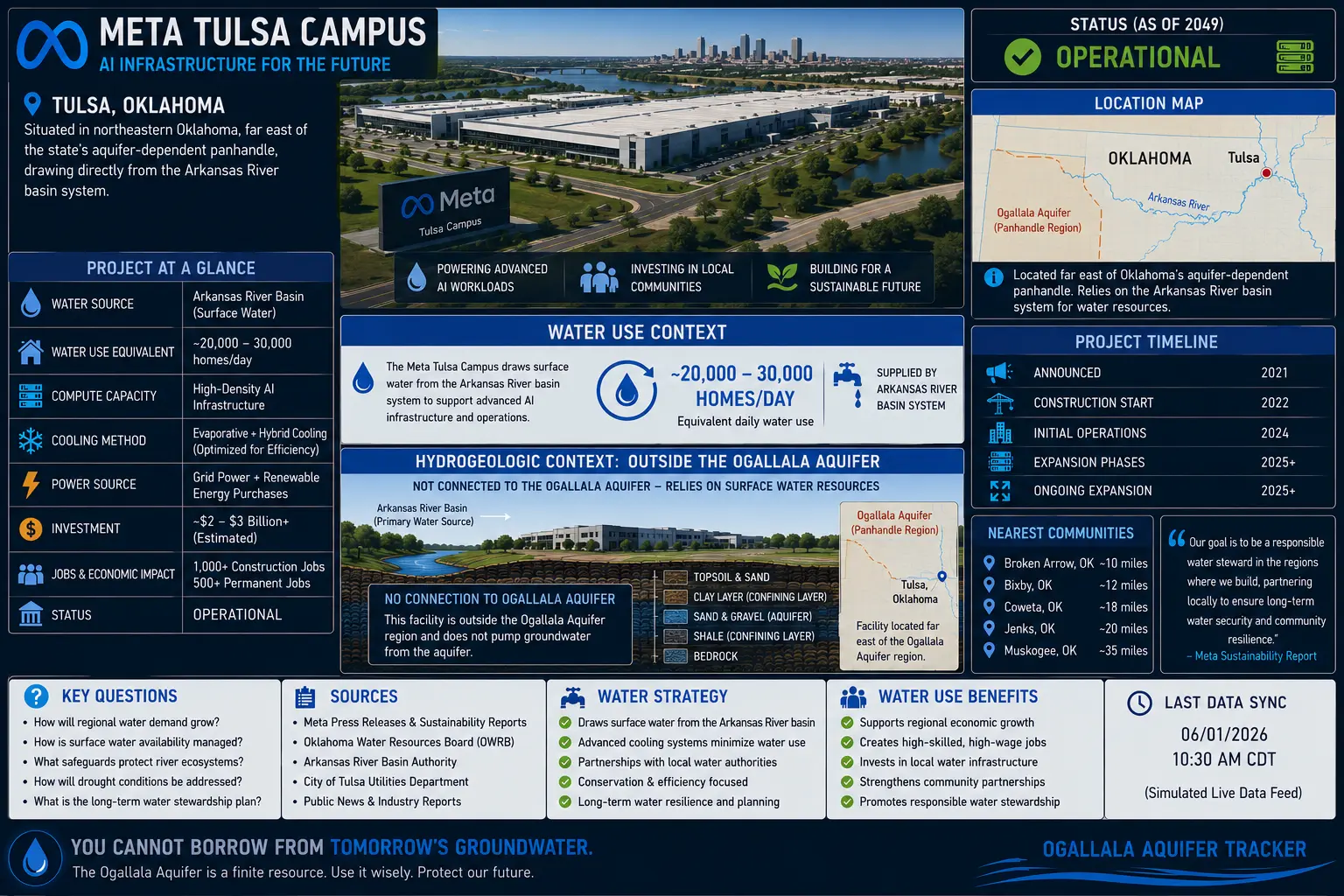
Meta Tulsa Data Center / Project Anthem — Oklahoma

Meta Tulsa Project Anthem data center campus profile in east Tulsa, Oklahoma

Recent Facility News & Public Records

Current company information, Tulsa incentive records, local-government action, independent reporting, and regional public discussion tied to Project Anthem.

Status, timeline, and scale correction: the supplied artwork labels Meta Tulsa operational, with a 2021 announcement, 2022 construction start, $2–3 billion investment, 500 permanent jobs, direct Arkansas River surface-water supply, and water use equal to 20,000–30,000 homes per day. Meta publicly identified the previously coded Project Anthem and broke ground in April 2026. The company’s current figures are more than $1 billion invested, over 1,000 workers at peak construction, approximately 100 operational jobs once complete, and more than $25 million for local road and water infrastructure. The reviewed official sources do not substantiate the artwork’s daily water, cooling, river-supply, or household-equivalency claims. The project is under construction—not operational.
April 2026 · Meta Data Centers · Official announcementMeta confirms Tulsa as its newest AI-optimized data centerThe company reports more than $1 billion in investment, more than 1,000 peak construction workers, approximately 100 jobs once operational, and over $25 million for roads and water infrastructure. April 2026 · PartnerTulsa · Local economic-development recordLocal and state leaders mark the official Project Anthem groundbreakingPartnerTulsa documents active construction and identifies the project as one of the region’s largest economic-development investments. February 2024 · City of Tulsa · Official incentive ordinanceCity records establish Project Anthem’s 340-acre incentive districtThe ordinance places the project near East 11th Street and the Creek Turnpike and documents the economic-development plan, affected taxing jurisdictions, public-review structure, and contemplated property-tax treatment. March 2026 · Tulsa City Council · Moratorium recordTulsa considers and approves a temporary pause on additional data centersThe council materials document the citywide review of data-center permitting and include Project Anthem facts; approved phases of Anthem were allowed to continue. April 22, 2026 · Public Radio Tulsa · Local public-media reportingMeta’s identity and community commitments become public amid regional concernReports Meta’s confirmation, promised jobs, clean-energy matching and water-efficiency claims, while noting broader public concern about northeast Oklahoma data-center development. April 21, 2026 · Reuters · Independent reportingReuters confirms construction has begun on the billion-dollar Tulsa campusPlaces the project in Meta’s broader AI-infrastructure expansion and distinguishes verified construction from future operational status.
Subscriber discussion preview

Discuss Meta Tulsa / Project Anthem

Members will be able to share sourced local observations and discuss water disclosures, infrastructure funding, zoning, incentives, construction, clean-energy claims, employment, noise, power demand, and community impacts.

What a subscriber should be able to answer

The Data Centers button is for the deeper investigation; Substack can point readers here when a project or groundwater development needs context.

Where is it?Show the facility on the same aquifer map readers already know, alongside the appropriate community reference points.
What is its real status?Separate operational, under construction, and proposed projects. Put the evidence date beside the status.
What do we actually know about water?Separate permits, company statements, modeled context, monitoring-well observations, and independent findings instead of blending them together.
“You cannot borrow from tomorrow’s groundwater.”

Version 3.4 makes the data-center story easier to investigate without overstating what the evidence proves.